Conquer the Messy Middle: Bridge the Gap Between Customer Problems and Business Impact

Pasi Lappalainen
January 17, 2026
Product management often suffers from a frustrating paradox. Teams are working harder than ever. Features are shipping at record speed. Every Jira ticket is marked "Done." Yet, the business needles—revenue, retention, or growth—barely move.
You are not suffering from a lack of effort. You are stuck in the "Messy Middle."
According to Mixpanel’s manifesto The Future Will be Decided in the Messy Middle, this is the "gulf of translation" between your high-level strategy and your day-to-day execution. Leaders stare at spreadsheets of lagging financial results, while teams stare at granular project lists. There is no shared model connecting the two.
The Leader’s Trap: Confusing Motion with Progress
Worse than the gap itself is how many leaders try to close it. They make the mistake of optimizing Output.
They obsess over the quantity of work and push for higher velocity. They operate under the belief that if the team just ships more, the numbers will eventually turn green. As noted in the manifesto, this creates a "feature factory" culture where output becomes the measure of success, even when it isn't tied to real impact.
To escape this trap, you must stop managing volume and start managing value. You need to build a Bridge.
You need a clear path from customer problems to business results. By adopting a structured Value Architecture, you replace chaos with clarity. Here is the framework you need: Impact, Outcome, and Opportunity.
1. Impact (Business Outcome)
What it is: This is the high-level truth of the company. It tells you if the business is thriving. Examples: Annual Recurring Revenue (ARR), Profit Margins, Retention (Churn), Market Share.
Many leaders make a critical error here: they ask teams to "optimize Impact" directly. The problem is timing. Impact metrics are almost always lagging metrics. As the manifesto highlights, relying on them is like checking the scoreboard after the game is over—they tell you the final result, but it is too late to change it.
Impact is the destination. It cannot be the map for daily decision-making because the feedback loop is simply too slow.
2. Outcome (The Bridge Metric)
What it is: This is the solution to the Messy Middle. An Outcome (or "Input Metric" in Mixpanel’s terms) measures the change in human behavior that occurs when a customer receives value from your product. Examples: Active usage of a core feature, successful workflow completions, or increased adoption rates within a specific segment.
An Outcome is the ideal goal for a product team for two reasons:
It is Influenceable: Unlike revenue, the team can move this number directly by improving the user experience.
It is Predictive: If the Outcome improves, it predicts a positive Impact in the future (e.g., higher engagement predicts lower churn).
3. Opportunity (Customer Problem)
What it is: Here is where we fundamentally shift away from the "Feature Factory." Instead of measuring Output (shipped features, velocity, or lines of code), we measure the Opportunity. This is the specific customer problem or friction point we need to solve. Examples: "I cannot demonstrate the value of my work to my manager" (Opportunity) vs. "Build a reporting PDF export" (Output).
Traditional planning focuses on Output. Teams get rewarded for "shipping the thing," regardless of whether it solved the problem. This creates a disconnect where work happens, but value is not created.
Opportunity thinking forces the team to ask a critical question: "What prevents the customer from achieving their goal?" When a team focuses on the Opportunity, they are empowered to find the best solution—whether that’s code, copy, or a process change.
The Hidden Danger: The Fallacy of Certainty
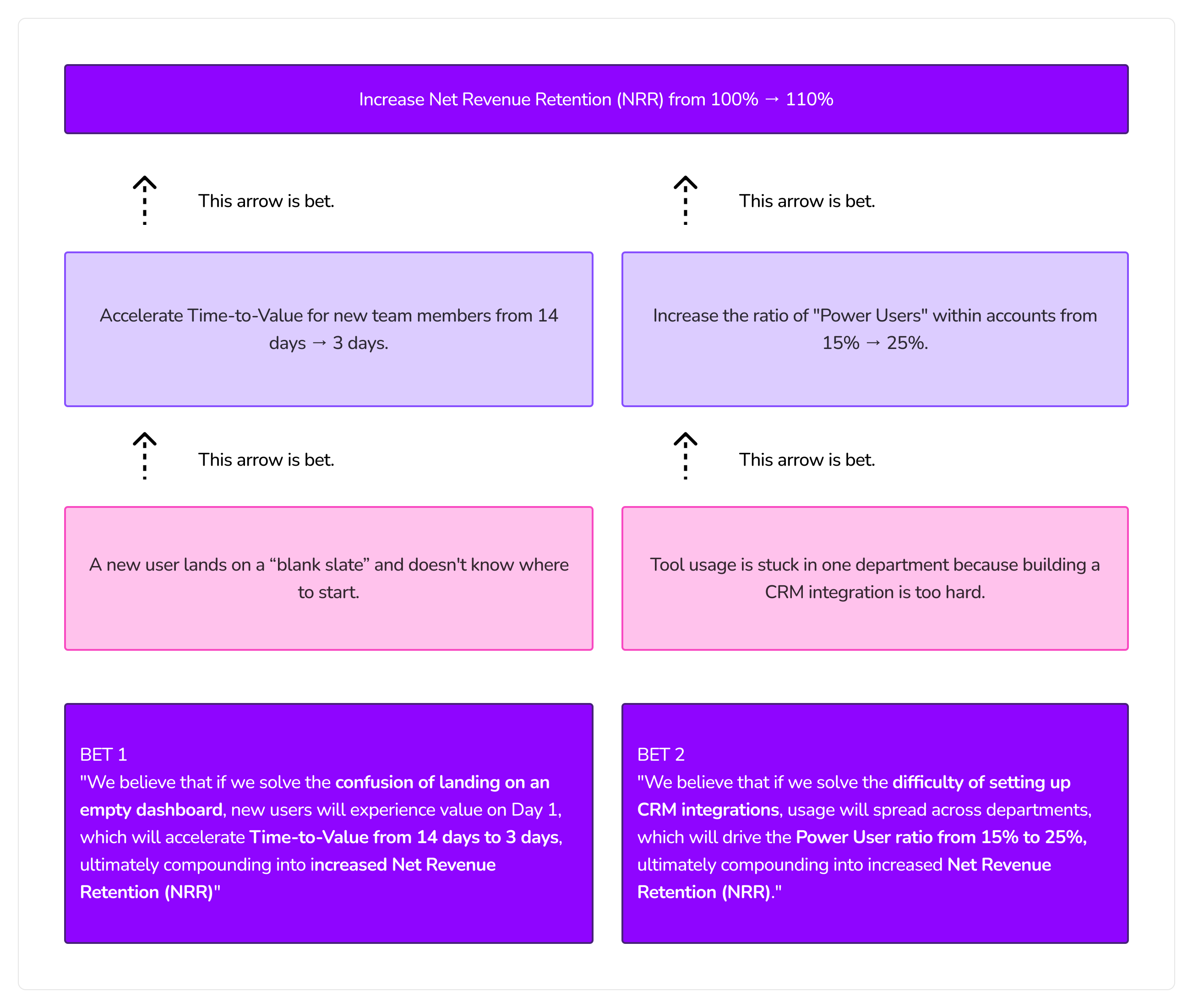
Here is where we must challenge the model. It is tempting to draw these three boxes—Opportunity, Outcome, Impact—and assume they form a perfect, straight line. We want to believe business is deterministic: "If we do X, Y will happen."
But the arrows between the boxes are not guarantees. They are bets.
As the manifesto suggests, a mature value architecture blends deterministic calculation (math) with probabilistic hypotheses (learning).
The Opportunity Bias: You might solve the customer's problem perfectly (Opportunity), but if that problem wasn't painful enough, their behavior won't change.
The Outcome Bias: You might change behavior (Outcome), but if you picked a vanity metric, it won't compound into revenue (Impact).
The Leader’s Job: Attack the Arrows A leader's primary role isn't just to define the boxes, but to validate the arrows connecting them. You must constantly ask: "What is the biggest risk that this cause-and-effect relationship is wrong?"
Don't just fall in love with your model. Fall in love with testing it.
Constructing Your Bridge: The Shared Hypothesis
To conquer the Messy Middle, your organization must move from managing by org chart to managing by cause-and-effect. You need a shared hypothesis connecting these three levels.
Crucially, this hypothesis does not belong only to the product team.
Marketing and Sales must share this logic. If Product builds for one Outcome (e.g., Retention), but Marketing promotes a different promise and Sales sells a different dream, the bridge breaks. You remain trapped in the Messy Middle.
Your entire organization must align on this simple logic flow:
"We believe that if we solve [Opportunity], customer behavior will change to drive [Outcome], which ultimately compounds into [Impact]."
A Practical Example: B2B SaaS
Imagine a company struggling with retention.
Impact (The Goal): Reduce Churn from 5% to 4%.
The Trap: Telling the team to "fix churn" is useless. It is a lagging indicator.
Outcome (The Bridge): Increase the "Weekly Report Generation" rate from 20% to 35%.
The Logic: Data shows that users who share reports with their bosses are significantly less likely to churn. This is the predictive bridge.
Opportunity (The Problem): "I spend 4 hours a week manually screenshotting data because the current charts look unprofessional."
The Execution: The team is not told to build a specific feature. They are told to solve this time-waste problem. They might build an export button, an email automation, or a better dashboard. The specific Output does not matter, as long as it solves the Opportunity and drives the Outcome.
Conclusion: Do Not Simply Do More. Do What Matters.
The Messy Middle is where strategy goes to die. It is filled with teams running fast but lacking direction.
To win, you must shift your focus from Output to Opportunity. Connect that work to Impact via clear, predictive Outcomes. But remember: The map is not the territory. Continuously challenge your arrows and validate your hypotheses.
When you do this, you ensure that every campaign, sales call, and line of code connects to a business result. You turn your data into a competitive advantage.
Do not let your strategy get lost in the noise. Build the bridge.
Sources:
Mixpanel: The Future Will be Decided in the Messy Middle
Tuumo: Product Metrics & Bridge Metrics framework